(Dated Nov. 6, but it's taken me a week to complete . . .that's the volcano, Mt. Erebus, in the background above. )
They say the first time you come to Antarctica, it's for the adventure.
The second time, it's for the money.
The third time, it's because your friends are here.
The fourth time, it's where you belong.
This is my fifth trip.
I got to Johnstown Nov. 9, 2010 and left to head back down here on Oct 31, 2011, just a little less than a year later. That's the longest I've been in the States at one time since I began wandering around back in Oct. 2004.
What did I do during that year?
Well, there were a couple weeks hunting deer unsuccessfully. There were a couple weeks celebrating the holidays. There were numerous months job hunting, eventually somewhat successfully. There were rounds of golf, almost no fishing and very little travel. After bouncing around three or four addresses, I rented an apartment. It was in the same complex that my folks moved to in 1952 or '53, my first home in Johnstown. There was no deja vu.
In June I went to work through a temp agency for a local electrical contractor. Southwest Pennsylvania is still economically depressed. The state doesn't license electricians although it licenses barbers. Anyone can do electrical work, but the pay isn't much. For the first month, I worked mostly nights in commercial buildings changing out fluorescent ballasts and lamps.
Then I moved to a crew in a powdered metals mill. The mill has gone through numerous owners and operations in it's 100+ year history. The powdered metal, mostly iron, is as fine as talcum powder. Five minutes after I started, I was filthy and stayed that way, no matter how often I washed. Needless to say, I don't want to work in a mill.
 The end of August, I landed a job with the state as a semi-skilled worker at Yellow Creek State Park. It was only a 33 cent pay cut.
 The park job is seasonal, but I like it. I mean, who wouldn't like working at a park? Pick litter, clean restrooms, cut grass, clean cabins, pick litter, cut grass, do minor maintenance jobs, pick litter, cut grass, return wandering pups, retrieve drifting sailboats . . .

It's a small park with a staff of ten, a good, friendly crew.

About the time I started at the park, some folks from the Antarctic program contacted me to ask if I'd be interested in working the summer, Nov. through mid-Feb. Again, long story short, my last day at the park was Oct. 21, I flew to Denver Oct. 27, to New Zealand Oct. 31 and here to McTown Nov. 4. My contract officially ends Feb. 15, but it can vary by a couple weeks. Supposedly, I can l start back at the park Mar. 26. How's that for timing?
If the job had been to work around McTown (McMurdo Station in case you don't recall) I may not have taken it. As it is, I am working with another great bunch, Science Construction. We're based here at McTown but will travel out to the field camps where scientists conduct research. That's kind of accurate; actually, we will be travelling out to set-up the camps. In most instances, we will camp out in Antarctica while we do our work. Good thing it's summer!
I expect to have a lot different photos. Good thing, because I think I posted photos of just about everything there is to photograph around town the last time I was here. As I mentioned in my email, I won't have much access to the Internet while I am out, but hopefully I'll be able to post when I get back to town.
The first day I arrived, I got my gear to my room and then headed to dinner. As I walked out of the dorm and across the parking lot to Bldg. 155, it was all extremely familiar to me. Too familiar.
It's unsettling that living in Antarctica is becoming second nature . . . .
Keep an eye on your email.
See ya later - Phil
 It took a while, but the Pine Island Glacier field camp was finally a reality. The first people started arriving on Dec. 27. By the time I made it to camp on Jan. 3, they were putting up the last structure. The longest, on the left, is the galley. You can see just a bit of the comms/management tent beyond it, then the medical tent and then two more, bright yellow and blue, for the scientists. There were two more similar to medical to the left of the galley. One was used by our science construction crew and the other was used by the camp staff mechanics and equipment operators.
 We each had individual tents for sleeping a couple hundred yards away from the galley and other rac tents. Eventually there were thirteen of us setting up the camp, a camp staff of ten (cooks, admin, physicians assistant), a helicopter technician and ten scientists. That's a sizable population for a field camp.
The scenery is described as 'flat white'. I guess that's what it's like anytime you're on a huge glacier. Like the South Pole - just warmer. Temperatures weren't all that bad. Charles, camp manager, mentioned it was about 7 degrees when I arrived. I know that's cold, but this is Antarctica. Also, when the sun is shining, it seems a lot warmer with all the reflection off the snow. I was expecting something more on the order of -10 or colder.
We each had individual tents for sleeping a couple hundred yards away from the galley and other rac tents. Eventually there were thirteen of us setting up the camp, a camp staff of ten (cooks, admin, physicians assistant), a helicopter technician and ten scientists. That's a sizable population for a field camp.
The scenery is described as 'flat white'. I guess that's what it's like anytime you're on a huge glacier. Like the South Pole - just warmer. Temperatures weren't all that bad. Charles, camp manager, mentioned it was about 7 degrees when I arrived. I know that's cold, but this is Antarctica. Also, when the sun is shining, it seems a lot warmer with all the reflection off the snow. I was expecting something more on the order of -10 or colder. This is inside the galley. We usually ate in two shifts. On the rare occasion that we all ate together, like Sunday brunch, it was a little cramped but we made it work.
I installed electric cables along ceiling and down the walls to outlets and equipment like the snow melters and water heater. I cinched them with ty-raps, but when this photo was taken, I wasn't finished. Normally, or maybe I should say ideally, the electricity is finished before the cooks start using the galley. But it didn't happen that way. Lighting came from plastic panels in the tent sections. It's summer down here and the sun is up 24/7.
Each section of the tent is 4' wide and about 8' at the peak. There is a separate piece of fabric for each that connect. The ends are plywood that comes apart. The floor is made of 4 by 8 foot shallow boxes turned upside down and latched together. When the tents are taken down, everything is packed into these floor sections with one portion as the bottom of the box and another as the top. Then they're stacked, strapped and moved with around fork lifts.
This is inside the galley. We usually ate in two shifts. On the rare occasion that we all ate together, like Sunday brunch, it was a little cramped but we made it work.
I installed electric cables along ceiling and down the walls to outlets and equipment like the snow melters and water heater. I cinched them with ty-raps, but when this photo was taken, I wasn't finished. Normally, or maybe I should say ideally, the electricity is finished before the cooks start using the galley. But it didn't happen that way. Lighting came from plastic panels in the tent sections. It's summer down here and the sun is up 24/7.
Each section of the tent is 4' wide and about 8' at the peak. There is a separate piece of fabric for each that connect. The ends are plywood that comes apart. The floor is made of 4 by 8 foot shallow boxes turned upside down and latched together. When the tents are taken down, everything is packed into these floor sections with one portion as the bottom of the box and another as the top. Then they're stacked, strapped and moved with around fork lifts. This was the tent next to the galley that our crew used.Heating comes from small, oil-fired stoves. Very warm. When we weren't working, eating or sleeping, this is where we spent most of our time. The fellow in the left rear is on the satellite phone that we had at our disposal. A lot of reading was done, but there was also a scavenger hunt, a couple guys were tying flys, the scientists set up some of their gear which resulted in a hot tub party and we had a reading of an original short story written by one of the carpenters.
Oh yeah - and we had a few beers and cocktails. It's a harsh continent, after all.
This was the tent next to the galley that our crew used.Heating comes from small, oil-fired stoves. Very warm. When we weren't working, eating or sleeping, this is where we spent most of our time. The fellow in the left rear is on the satellite phone that we had at our disposal. A lot of reading was done, but there was also a scavenger hunt, a couple guys were tying flys, the scientists set up some of their gear which resulted in a hot tub party and we had a reading of an original short story written by one of the carpenters.
Oh yeah - and we had a few beers and cocktails. It's a harsh continent, after all. This was the view out the front door of the tent. A little overcast and breezy, but not too bad.
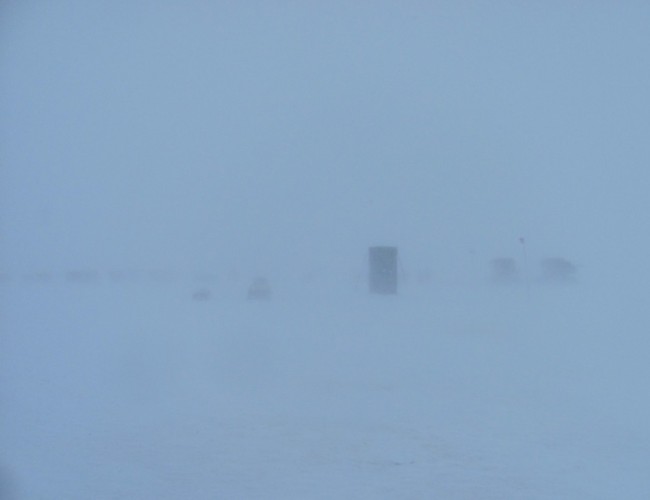 This is that same view when a storm blew in - and I do mean BLEW. Charles said the winds got up to 40 mph over night during the first storm. We had two storms for a total of about three days. For the most part, it was sunny and beautiful, with little or even no wind at all.
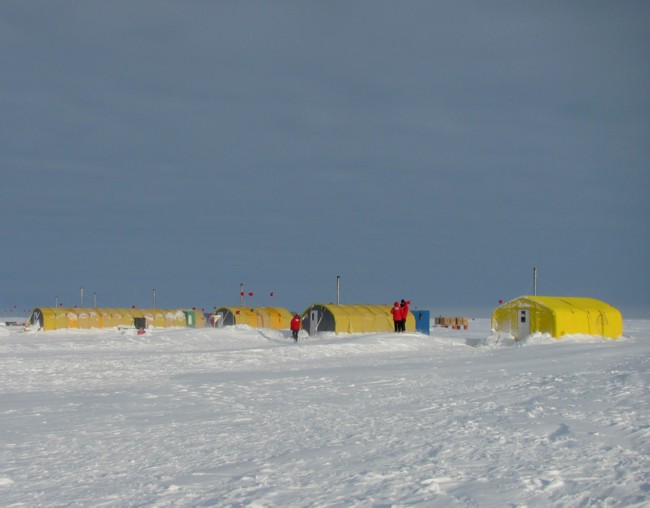 It was difficult to say how much snow fell, but there was a lot of drifting. A lot of time was spent digging out with equipment heavy equipment and a lot of shovels . You can see it drifted around the tents.
The purpose of the PIG field camp was to support the scientists' drill camp on the ice shelf about 40 miles away. The scientists were to use a water drill to go down through the shelf, I believe about 500 meters, to do research and monitor the water beneath the shelf.
The plan was to have two helicopters torn down, shipped in the C-130's to PIG, reassembled and used to ferry the scientists out and back.
It was difficult to say how much snow fell, but there was a lot of drifting. A lot of time was spent digging out with equipment heavy equipment and a lot of shovels . You can see it drifted around the tents.
The purpose of the PIG field camp was to support the scientists' drill camp on the ice shelf about 40 miles away. The scientists were to use a water drill to go down through the shelf, I believe about 500 meters, to do research and monitor the water beneath the shelf.
The plan was to have two helicopters torn down, shipped in the C-130's to PIG, reassembled and used to ferry the scientists out and back.
 As I wrote, it's pretty nice when it's not storming.
This gantry was to be used on the helicopters. A large piece of equipment was supposed to be on site to assist in erecting it. For whatever reason, that piece of equipment wasn't there. Apparently the boss suggested digging a pit deep enough to assemble the gantry from 'ground' level. That wasn't a big hit with the crew. One of them came up with this wooden frame. The small fork lift raised it high enough to get the top beam in place and, when it was time, back down again while the legs were walked out on the ground. These folks are really a resourceful bunch.
Because of all the delays, the helicopters never made it to camp. Instead, a Twin Otter plane was sent for two days to carry a few of the scientists out to set up some monitoring stations. In other words, after a month of waiting, the PIG project only got about two days of science done on the shelf. However, they'll be back next year.
I was only at camp a week. Eight of us came back to McMurdo on Jan. 10, while four others took our place. They will join the people that remained to take down the tents and other equipment, pack it and store it on site to be used again next year. Those folks are scheduled to return to McMurdo next Saturday.
Me? Tomorrow I'll take my first helicopter ride when I go out to Marble Point, a refueling site for the helicopters going to the Dry Valley sites. It's a three or four day gig (weather permitting). Who knows, maybe I'll be back with more photos next week.
As I wrote, it's pretty nice when it's not storming.
This gantry was to be used on the helicopters. A large piece of equipment was supposed to be on site to assist in erecting it. For whatever reason, that piece of equipment wasn't there. Apparently the boss suggested digging a pit deep enough to assemble the gantry from 'ground' level. That wasn't a big hit with the crew. One of them came up with this wooden frame. The small fork lift raised it high enough to get the top beam in place and, when it was time, back down again while the legs were walked out on the ground. These folks are really a resourceful bunch.
Because of all the delays, the helicopters never made it to camp. Instead, a Twin Otter plane was sent for two days to carry a few of the scientists out to set up some monitoring stations. In other words, after a month of waiting, the PIG project only got about two days of science done on the shelf. However, they'll be back next year.
I was only at camp a week. Eight of us came back to McMurdo on Jan. 10, while four others took our place. They will join the people that remained to take down the tents and other equipment, pack it and store it on site to be used again next year. Those folks are scheduled to return to McMurdo next Saturday.
Me? Tomorrow I'll take my first helicopter ride when I go out to Marble Point, a refueling site for the helicopters going to the Dry Valley sites. It's a three or four day gig (weather permitting). Who knows, maybe I'll be back with more photos next week.


